Software Has Been Built Backwards for 30 Years. Here's the Fix.
Introducing Application Networking-First (ANF): the architectural paradigm that makes Zero Trust the starting point, not the afterthought.
The sequence is so familiar that most engineers have stopped questioning it. You build the application. You containerize it. You push it to Kubernetes. And then you spend the next several weeks — sometimes months — trying to make it talk to other services securely.
Security is bolted on after the fact. Networking is negotiated once the code is already running. The result is a fragile, expensive, breach-prone infrastructure that the entire cloud-native industry has normalized as simply "the way things are done."
It does not have to be this way. And at Hopr, we have spent the past three years proving it.
The approach we call ANF changes the fundamental sequence of how cloud-native applications are built, secured, and deployed. Not incrementally. At the foundation.
The Problem: Three Decades of Getting the Sequence Wrong
The application-first model became dominant for understandable historical reasons. When distributed systems were young, perimeter security was considered adequate, the network was relatively simple, and the idea of cryptographically verifying every inter-service connection at every session was computationally expensive and operationally impractical.
None of those constraints exist today. And yet the development methodology has not changed.
Here is what the traditional application-first workflow actually costs in practice:
The PKI Tax. Every microservice needs a certificate. Certificate authorities need to be provisioned, managed, and maintained. Rotation schedules have to be enforced — and when they slip, production outages follow. A single expired certificate in a dependency chain can cascade silently until something breaks. DevOps teams across the industry spend thousands of engineer-hours per year managing this overhead. It is a tax on velocity that produces no business value.
The YAML Wall. Connecting a dozen services in a Kubernetes cluster requires hundreds — sometimes thousands — of lines of YAML configuration. Namespace definitions, DNS entries, port assignments, ingress rules, mTLS configurations, network policies: each file hand-crafted, each interdependency manually maintained. Based on Hopr's own engineering team analysis of network compositions performed during Lane7 development, manual composition of application networks produces an average of 8 to 12 bugs per network — from DNS typos to port conflicts that remain invisible until runtime. [1]
The Day 2 Delay. Under time pressure, security hardens from a Day 0 requirement into a Day 2 intention. Teams ship to production with known gaps, planning to close them after the launch. Frequently, those gaps persist into the next sprint cycle, and the one after that.
The numbers that result from this pattern are not abstract. In 2024, 84 percent of security professionals experienced at least one API security incident. [2] In the past two years, 57 percent of organizations reported API-related data breaches — many of them repeatedly. [3] Fewer than one in five organizations consider their current defenses highly effective against API attacks. [2] The average cost of a U.S. data breach reached $10.22 million in 2025. [4]
This is not a resource problem. It is not a talent problem. The industry has talented, motivated engineers working on this everywhere. It is an architectural problem — and the architecture is the thing we have not been willing to change.
The Inversion: Application Networking-First
Application Networking-First reverses the sequence at the foundational level.
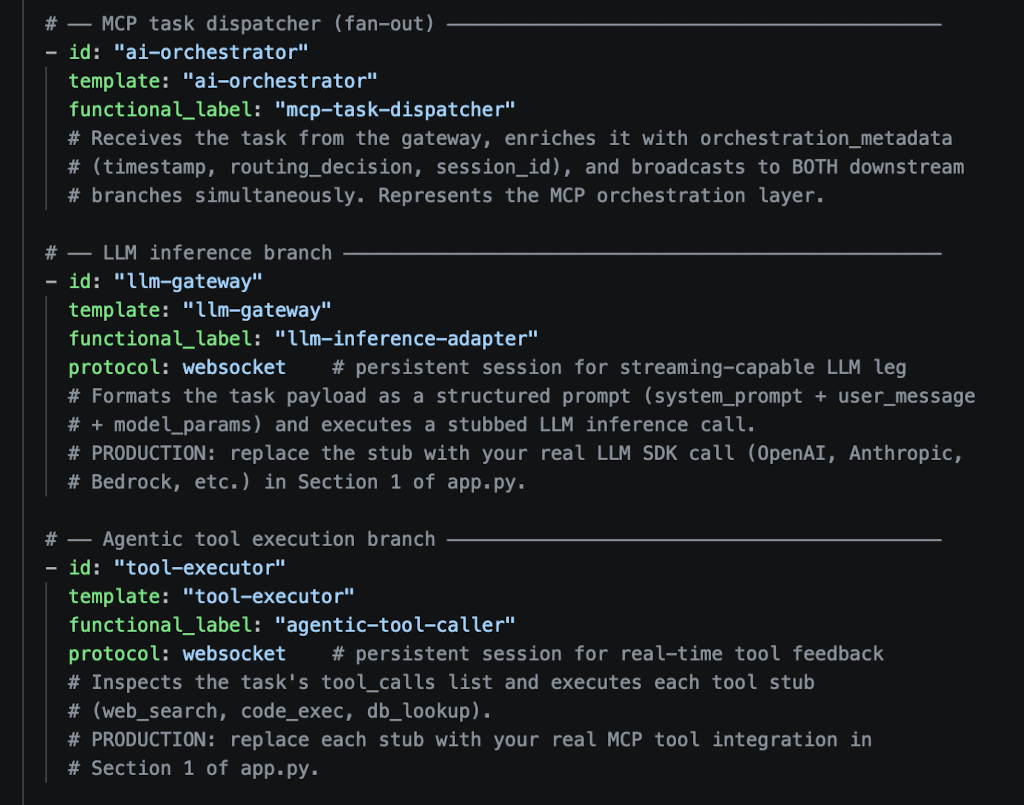
Figure 1: Lane7 Topology simply defined by YAML specs.
In the ANF model:
The network topology is defined first. Before a single line of application logic is written, the communication architecture is declared explicitly: which services communicate with which, what protocols govern each connection, what authorization scope each pod holds, what trust boundaries the network enforces.(Figure 1 YAML topology)
Security is embedded within a "blueprint" topology. There is no separate "add security" step, because security is an inherent structural property of the topology declaration. The moment you define the topology, you have defined the security model. They are the same artifact.
Business logic is injected into a pre-secured, pre-wired environment. Developers write their application logic and drop it into pre-defined customization zones within a running, already-secured application network. The network does not change when the logic changes. The security posture does not change when the logic changes.
The consequence of this inversion is architectural, not operational: security cannot be skipped, delayed, or misconfigured, because it is not a configuration layer applied on top of a finished application. It is built into the process by which the application comes to exist at all. Day 0 Zero Trust stops being aspirational and becomes structural.
How Lane7 Blueprints Implement ANF
Lane7 Blueprints are Hopr's production implementation of the Application Networking-First paradigm. They are pre-configured, production-ready Kubernetes deployment packages that operationalize ANF for DevOps and Platform Engineering teams in four steps.
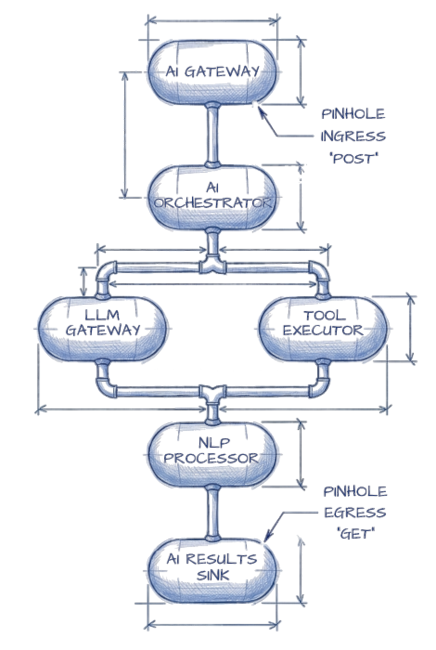
Figure 2: A schematic representation of an Agentic AI bueprint
Step 1 — Select a Blueprint. Choose a named architectural pattern from the Lane7 Blueprints catalog. Each Blueprint represents a specific communication topology: the Bi-Pod Relay for A-to-B-to-A request flows, the Tri-Pod Fan-Out for broadcast distribution, the Quad-Pod Fan-Out-In for parallel processing pipelines. The pattern defines the structure; you define the purpose.
Step 2 — Define the Topology. Write a topology.yaml file — approximately 25 lines — that declares how Blueprint components connect: which pods are upstream, which are downstream, what protocols govern each channel. This file is the authoritative artifact. Everything downstream of it is deterministic.
Step 3 — Compose and Wire. Run the Lane7 CLI (lane7-compose). The CLI reads your topology.yaml and automatically generates all Kubernetes manifests, configures cross-namespace DNS, assigns ports, and instantiates a Korvette-S Workload Security Proxy (WoSP) sidecar for every pod in the network. What would require hundreds of hand-crafted YAML files and days of configuration is produced in seconds, deterministically, without the possibility of human configuration error. [1]
Step 4 — Inject Business Logic. The composed network is running, secured, and ready. Developers open the pre-configured application in each pod, locate the customization zone — Section 1 of the app code — and replace the placeholder logic with their own. The network configuration never changes. The security posture never changes. Only the business logic changes.
The result: a fully operational, Zero Trust application network in under 30 minutes. [1]
What "Secure by Default" Actually Means in ANF
The phrase "secure by default" is overused in security marketing, applied to products that still require significant security configuration before production use. In Lane7 Blueprints, it means something specific and mechanically verifiable.
Every connection in a composed Lane7 network is protected by the Korvette-S WoSP, which implements three foundational cryptographic innovations:
CHIPS™ (Codes Hidden In Plain Sight). A proprietary algorithm that generates ephemeral symmetric keys without any key exchange. Both communicating workloads independently derive the same key — meaning the key is never transmitted, never exposed in transit, and therefore cannot be intercepted regardless of what an adversary controls on the network path.
SEE™ (Synchronous Ephemeral Encryption). End-to-end encryption at Layer 7 without key exchange. Unlike TLS and mTLS, which depend on certificate handshakes that produce observable negotiation artifacts, SEE™ produces encryption that leaves nothing for an adversary to capture, analyze, or attempt to decrypt. Encryption keys rotate per session and per minute.
MAID™ (Machine Alias Identity). A cryptographic workload identity credential rooted in each workload's communication history. An attacker presenting a stolen identity credential, or no MAID™ at all, fails identity trust verification at the connection level — before reaching any API endpoint, before any data is exchanged.
Together, these innovations produce what Hopr calls Cloud Native Automated Moving Target Defense (AMTD): the attack surface shifts continuously, rendering captured credentials worthless within the lifespan of a single session. An attacker who successfully captures a credential cannot exfiltrate it because egress routes are topologically constrained.
Gartner, which formally defined AMTD as a security category in February 2023 and predicted it would displace at least 15 percent of traditional detection-and-response-only solutions, has named Hopr as a representative vendor in its research on the future of cyber defense. [5] That recognition reflects not just a product feature but an architectural approach — the defense is built into the structure of the application network, not bolted on top of it.
ANF and the AI Development Revolution
Generative AI has changed software development faster than any technology shift in the past two decades. AI coding assistants write microservice logic competently and at unprecedented speed. What they do not do — and cannot do reliably — is generate correct Kubernetes networking configuration, mTLS setup, cross-service credential management, or network security policy.
This creates a structural problem that is worse than the one it replaces. AI-assisted development dramatically accelerates the velocity of Application-First code. Teams ship logic faster than ever, with the same security gaps, at larger scale. The YAML Wall does not get shorter because an AI wrote the service behind it. The PKI Tax does not disappear because an assistant generated the business logic in thirty seconds. The Day 2 security delay gets longer, not shorter, when logic ships in hours instead of weeks.
ANF is the structural complement to AI-generated development — not a constraint on it.
The ANF workflow divides naturally along the same line that separates what AI does well from what it does poorly. The topology.yaml — 25 lines, declarative, schema-validated — defines authorized network paths and security policy. It is a design artifact that expresses intent at the right level of abstraction for both architect authorship and AI-assisted generation from natural-language system descriptions. The customization zone (Section 1 of each pod's application) contains the business logic — exactly what AI coding tools generate well. The lane7-compose CLI generates all network manifests deterministically from the topology — cross-service consistency, DNS resolution, port assignment, Envoy configuration — produced correctly in seconds, which is exactly what AI tools cannot do reliably.
In an ANF workflow, AI tools are scoped to what they do well and structurally excluded from what they do poorly. AI velocity and security rigor compose rather than trade off.
ANF Contains the Failure Mode of AI-Generated Code
There is a harder question worth addressing directly: what happens when AI-generated code contains a vulnerability? Vibe-coded services, AI-generated microservices with unreviewed logic, third-party AI components integrated without full source inspection — these are now common deployment realities.
In an Application-First environment, a compromised AI-generated service has access to whatever network paths were configured at deployment. Because security is added after the fact, that is often far more than it should be. Lateral movement is available.
In an ANF environment, a compromised service can only communicate with the workloads explicitly declared as its downstream targets in the original topology file. It cannot reach internal databases, adjacent services, or secrets stores that were not declared at composition time. Every unauthorized connection attempt is rejected before the first byte is exchanged. The blast radius of a compromised AI-generated component is bounded by its authorized communication footprint — which ANF makes narrow by construction.
ANF does not make AI-generated code safe. It makes AI-generated code's failure mode manageable at the network layer.
Securing the Agentic AI Pipeline
Multi-agent AI systems — networks of LLMs, orchestrators, tool-calling services, and data sinks — represent the fastest-expanding and highest-value API attack surface in the enterprise today. They are also the most demanding ANF use case, for three reasons specific to how AI agents work.
Multi-hop routing creates lateral movement risk. An AI pipeline with an orchestrator, parallel inference workers, a tool executor, and a results aggregator has multiple inter-service API connections. Each is a potential attack path. In Application-First deployments, a compromised inference worker can reach any other service its credentials allow.
Prompt injection via network interception is a novel attack vector. If an attacker can intercept inference traffic between an orchestrator and an LLM inference pod, they can inject a malicious prompt that modifies the agent's behavior without triggering any behavioral alert — the injected behavior looks like legitimate agent reasoning to any external observer.
Tool call authorization scope is unbounded by default. In a typical agentic architecture, an AI agent can call any tool its API credentials authorize. An agent compromised by prompt injection or a logic vulnerability can call those same tools maliciously, with no network-layer constraint.
Lane7's Agentic AI Blueprint addresses all three at the topology level. The reference architecture — HTTP gateway, AI orchestrator running a bounded ReAct loop, parallel LLM inference and tool execution branches over WebSocket, NLP fan-in processor, results sink — is a composable 6-pod blueprint with AMTD protection on every inter-pod connection.
AMTD credential rotation defeats prompt injection via network interception: rotating CHIPS™ keys mean any intercepted session credential is worthless before it can be reused. Topology-level microsegmentation contains a compromised pod to its declared communication footprint: an attacker inside a compromised inference pod cannot reach any workload not declared as a downstream target at composition time. MAID™ identity verification at every session rejects synthetic credentials that cannot reproduce the legitimate workload's communication history.
No code changes to the AI pipeline. No operator-managed cryptography. The topology provides the guarantee.
Where to Start
Application Networking-First is a paradigm shift, which means it requires one thing before everything else: seeing it work.
Lane7 Blueprints are free to download from the catalog at hopr.co/lane7. A standard Bi-Pod deployment — a secured A-to-B-to-A relay with Zero Trust identity verification and AMTD protection — runs in under 30 minutes from download to operational. A 30-day Korvette-S WoSP trial license is available with no commitment.
The industry has been building software in the same sequence for thirty years. The PKI Tax, the YAML Wall, and the $10.22 million average breach cost are the receipts for that approach.
ANF is the architectural correction. The topology comes first.
[1] Hopr Corporation. Engineering Retrospective: Manual Application Network Composition Error Analysis. Internal Technical Report, 2026. Available from Hopr on request.
[2] Akamai Technologies. API Security Research Report. 2024.
[3] Traceable AI. State of API Security Report. 2025.
[4] IBM Security. Cost of a Data Breach Report. 2025.
[5] Gartner. Emerging Tech: AMTD Advances Proactive Cloud Defense. January 2024. Hopr Corporation is named as a representative vendor in Gartner's research on Automated Moving Target Defense. Gartner does not endorse any vendor, product, or service depicted in its research publications.
Hopr provides Cloud Native Automated Moving Target Defense for enterprise workloads, APIs, and data in transit. Hopr's patented CHIPS™ technology, SEE™ protocol, and MAID™ identity credential enable cryptographically verified, quantum-proof, end-to-end encrypted inter-workload communication across all cloud environments — without PKI certificates, without key exchanges, and without modification of existing application code.