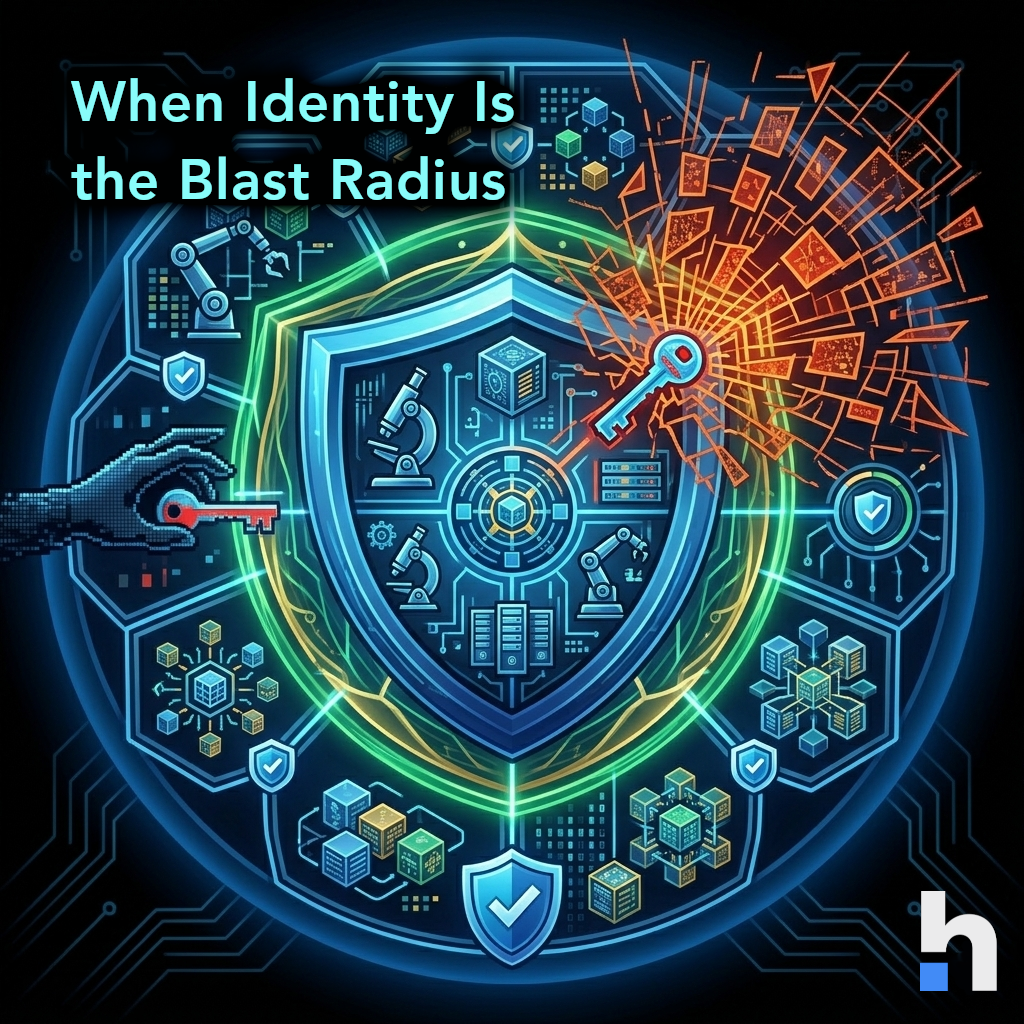
Securing Machine-to-Machine Trust in the Era of Infostealers
Recent catastrophic cyberattacks within the global medical manufacturing sector have forced the cybersecurity industry to confront an uncomfortable truth: the most devastating breaches of 2026 are not the result of zero-day exploits or highly sophisticated malware bypassing next-generation firewalls.
They are the result of $20 infostealer logs purchased on the dark web.
When advanced threat actors—including nation-state proxies—acquire legitimate administrative credentials, the network perimeter doesn’t fail; it is legally bypassed. The attackers simply walk through the front door, weaponize native IT management tools, and deploy destructive payloads.
But the true crisis of these recent events isn't just the mass wiping of employee laptops. It is the cascading, prolonged paralysis of core business logic—electronic ordering systems, supply chain logistics, and OT telemetry—that occurs when an organization’s central human Identity Provider (IdP) is compromised. What does a human IdP have to do with machine identities? Keep reading to learn the answer.
To prevent global supply chains and critical hospital infrastructure from being taken offline by a single stolen password, enterprise architecture must evolve. We must fundamentally decouple Machine-to-Machine (M2M) trust from human identity.
The Architectural Flaw: When Human Identity Dictates Machine Trust
In traditional enterprise architectures, Microsoft Active Directory or Entra ID serves as the ultimate source of truth for both human users and machine identities (via Service Principals or App Registrations).
When a microservices-based electronic ordering system processes a transaction, the web frontend must securely authenticate to the inventory database. In legacy designs, this M2M communication relies on the central IdP.
When attackers compromise a Global Administrator account, they don't just gain the ability to read emails or abuse Mobile Device Management (MDM) platforms. They gain the authority to alter, revoke, or spoof the machine identities that internal servers use to communicate. The business logic is suddenly held hostage. Even if the backend Linux servers are untouched by a Windows-based wiper malware, the applications cannot securely talk to each other. The supply chain halts.
The Trust Flaw: Static Access Credentials and Implicit Trust
Even if an organization attempts to separate human and machine identities, legacy architectures suffer from a second fatal vulnerability: the way machines authenticate and authorize one another is inherently static and disconnected.
Microservices, databases, and APIs typically rely on long-lived API keys, fixed service account passwords, or static TLS certificates (PKI keys) to establish trust. Once attackers bypass the human perimeter and land on an internal server, they can easily harvest these static secrets from configuration files, environment variables, or memory dumps. Because these credentials rarely change, the attacker has unlimited time to map the internal network and impersonate legitimate workloads.
This authentication failure is compounded by a fundamental flaw in authorization. In traditional environments, communication routing and access policies are entirely decoupled from cryptographic identity. Network engineers are forced to rely on IP-based firewall rules or broad service mesh configurations to authorize traffic. Because these independent policy authorizations lack true identity and trust verification, they inevitably introduce human-error vulnerabilities and excessive privileges. To ensure complex applications don't break, networks frequently default to implicit trust—such as "allow all" within a subnet or virtual private cloud (VPC)—creating a massive blast radius where any compromised node can freely attack its neighbors.
The AMTD Paradigm Shift: Decoupling Trust with Workload Security
True Zero Trust requires operating under an "assumed breach" mentality. You must assume the human identity layer will be compromised. The goal is to build Application Networks that survive that inevitability.
This is where Cloud Native Automated Moving Target Defense (AMTD), powered by solutions like Hopr’s Korvette-S Workload Security Proxy (WoSP), changes the mathematical outcome of a breach.
By deploying Korvette-S as a sidecar proxy to high-value workloads, organizations achieve autonomous, mathematically enforced isolation. Here is how it neutralizes the blast radius of a compromised IT perimeter:
1. Autonomous Machine Identity (MAID™)
Korvette-S entirely decouples workload security from corporate Active Directory. It assigns continuously rotating Machine Alias IDs (MAIDs) to protected workloads. If an attacker with a stolen Global Admin token attempts to pivot from a compromised IT environment into a Hopr-protected backend API, they hit a brick wall. The proxy does not respect the human administrative hierarchy; it only routes traffic for verified MAIDs.
2. Synchronous Ephemeral Encryption (SEE™) and The CHIPS™ Algorithm
Identity alone is not enough. To establish an End-to-End Encrypted (E2EE) tunnel, both the sending and receiving workloads must independently execute Hopr's Codes Hidden In Plain Sight (CHIPS™) algorithm to synchronously generate identical, ephemeral session secrets. Keys are never exchanged over the network. If an attacker tries to inject a payload, their machine cannot generate the matching secret, and the connection drops. Furthermore, this renders massive data exfiltration (like the terabyte theft claims we frequently see in hack-and-leak operations) impossible, as any intercepted data is unreadable ciphertext. And because of the third neutralizer below, any stolen data has no route out to hacker command.
3. "Secure by Design" (Eradicating Policy Debt)
Traditional Service Meshes often default to "allow all" internal traffic, requiring exhausted network engineers to maintain thousands of complex YAML routing policies. A single misconfiguration creates a lateral backdoor. Korvette-S is Secure by Design. Authorization is embedded directly into the deployment topology. If a connection between two workloads isn't explicitly mapped at deployment, the proxy literally does not know how to route it. There are no broad policies for an attacker to exploit.
Protecting the IT/OT Bridge
The most critical application of the ZT and AMTD architecture is securing the boundary where the corporate IT network meets Operational Technology (OT)—such as the deterministic Linux and RTOS environments running surgical robotics or manufacturing floors.
By establishing a Korvette-S WoSP application network at the Industrial DMZ (iDMZ), organizations cryptographically prove that a wiper malware devastating the corporate Windows environment cannot traverse the telemetry tunnel into the surgical suite. It turns security from a liability into a highly visible business enabler, allowing hospitals to maintain connections to life-saving equipment even when the vendor's IT perimeter is burning.
Rebuilding for Resilience
When a catastrophic breach occurs, the instinct is to rush and rebuild the systems quickly. As a result, the exact same architecture is rebuilt with longer passwords and stricter MFA. But you do not rebuild a burned house with the exact same flammable materials.
By integrating Cloud Native AMTD into the "Day Two" recovery—or proactively deploying it around crown-jewel assets today—enterprises can ensure that their revenue-generating business logic and critical OT environments remain untouchable, regardless of what happens to the human identity perimeter.
Would you like to explore how Hopr can establish a "Clean Room" Proof-of-Concept within your environment to secure your critical M2M workflows independent of your current IdP? Let's map out a secure Application Network today.