Oops! Something went wrong while submitting the form.
Zero Trust Without the "Complexity Tax"
Stop wrestling with complex service meshes, brittle mTLS configurations, and manual certificate rotation. Get security-as-code with a lightweight Envoy sidecar that just works.
Why Platform Teams Are Burning Out on "Traditional" Zero Trust
Pain Point 1: The "YAML Hell" of Service Mesh
The Reality: Implementing Istio or Consul requires managing thousands of lines of config, DestinationRules, and VirtualServices. It adds a heavy, centralized control plane that eats CPU and complicates debugging.
Pain Point 2: The "Certificate Rotation" Nightmare
The Reality: Manual certificate management is a ticking time bomb. Automating rotation across thousands of ephemeral containers is brittle, and one expired cert can bring down production.
Pain Point 3: The "Secret Zero" Problem
The Reality: How do you deliver the first secret to a workload securely? Most solutions just kick the can down the road, forcing you to hardcode long-lived bootstrap credentials (the "Secret Zero") that are easily stolen.
Meet the Workload Security Proxy (WoSP)
We built our Korvette-S WoSP on a simple premise: East-West security should be a feature of the infrastructure, not a burden on the developer.
Korvette-S
Workload Security Proxy
No Central Control Plane: Unlike Istio, each WoSP is autonomous. No heavy Istiod to manage, patch, or scale.
Automated E2EE: We replace complex mTLS handshakes with our patented Synchronous Ephemeral Encryption (SEE™). It builds end-to-end encrypted channels on demand without a key exchange.
Solved "Secret Zero": We eliminate the need for bootstrap secrets. Our CHIPS™ technology allows workloads to generate their own high-trust secrets locally.
The Korvette-S WoSP is a lightweight, drop-in sidecar that handles all identity, encryption, and trust verification for you. It sits alongside your workload in Kubernetes (or legacy VMs) and offloads the entire Zero Trust logic.
The WoSP is a pluggable solution to assure "Secure by Default" application networks and it rejects all attempts of threats to access a trusted workload.
Deploy in Minutes, Not Months
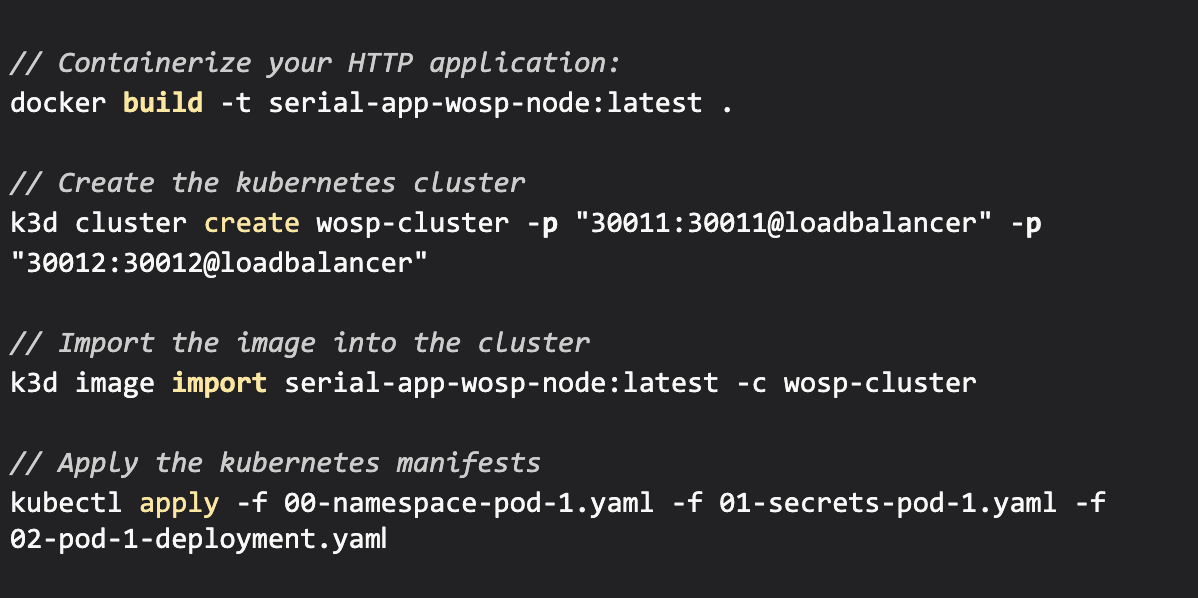
Lane7 blueprints simplify and accelerate the deployment of Zero Trust application networks
A few terminal commands are all that it takes to deploy a Layer-7 application network that is Zero Trust and Secure by Default. Customize only the app business logic to suit your use case.
Hopr's WoSP versus "The Old Way"
Comparing Traditional Service Mesh with Hopr's WoSP-enabled Zero Trust App Network
Architecture
Identity Rotation
Multi-Cloud
Implementation Time
Hopr's Lane7 blueprints enable Platform Engineers and DevOps to quickly and simply build "Secure by Default" application networks in all clouds.
We've made it quick and easy for DevOps and Platform Engineers. Our Lane7 product is a collection of blueprints for different types of application networks.
Blueprints are pre-configured, WoSP-enabled, reusable application networks. They're ready to deploy and customize in a local environment.
Feature by Feature Comparison
Feature
Others
Hopr rotates the identity and secret credentials at high frequency.
Existing solutions rely on static or semi-static credentials that are easy targets for adversaries.
Hopr verifies trust in a workload identity at each session.
Automated PKI certificate identities, may be self-signed, seldom rotate and lack a workload identity chain of trust.
Hopr immediately discovers compromised API key and prevention of their misuse by threat actors
Conventional authentication cannot recognize compromised keys when they arrive for authentication. Stolen keys are easily abused.
Hopr scales with operations in real-time and in all environments.
Existing solutions can't operate across all cloud environments in real time and interrupt operations to rotate secrets.
Hopr hardens access to both endpoints to prevent attacks.
Existing solutions may protect the API endpoint, but do not protect the client endpoint in an exchange.
Hopr ensures bi-directional confidentiality and integrity of data in transit between endpoints.
Existing solutions may use TLS or mTLS, but these may not be present everywhere, leaving data exposed.
Hopr rejects all malware from untrusted source before it reaches an endpoint.
Existing solutions may scan traffic for malware, but inspection can't find all malware before it is delivered to an endpoint.
Hopr eliminates the "secret zero" problem since secrets aren't stored.
Secrets vaults require more access keys. Creating a chain of keys and storage.
Stop configuring certs. Start shipping code.
See for yourself just how simple and fast it is to deploy WoSPs and build a Zero Trust application network that is Secure by Default. Lane7 is a collection of pre-configured "blueprints" ready to use with your apps. Signup and get a FREE Lane7 blueprint for a "2-node app network" and see how simple and fast app networks can be deployed.